Within Rendlesham
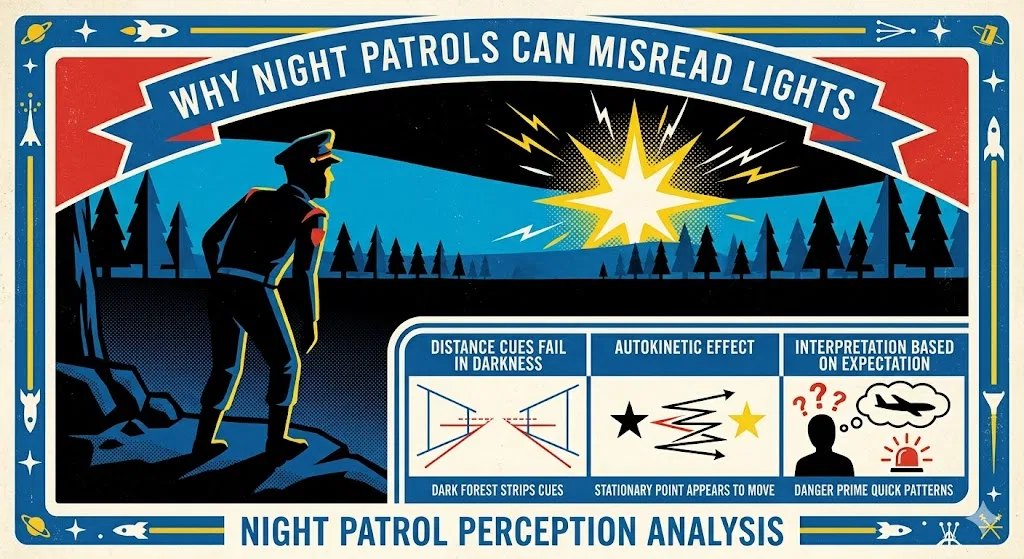
Why Night Patrols Can Misread Lights
Fatigue, darkness and alertness can make ordinary lights seem strange, especially during security work.
On this page
- Darkness and distance cues
- Stress and expectation
- Training limits in ambiguous scenes
Page outline Jump by section
Introduction
Night patrol perception is central to the Rendlesham Forest UFO incident because the first reports began as security personnel trying to interpret strange lights in darkness, from a base perimeter, while alert to possible danger. The most cautious reading is not that fatigue or misidentification automatically explains every witness memory, but that the conditions were unusually good for ordinary lights to look extraordinary: a dark forest, uncertain distances, flashing lights in the direction of the coast, an expectation that something may have come down, and later group discussion around an alarming event. The official archive record still treats the case as “unexplained lights” rather than a resolved aviation threat, while sceptical reconstructions argue that a fireball, the Orford Ness lighthouse and bright stars could have been misread by observers working under night-watch conditions.[The National Archives+2Wikipedia]nationalarchives.gov.ukThe National ArchivesUFO reportsThe MOD continued to state there was no threat to UK airspace or national security, and no further record…
Why darkness made the scene hard to judge
The first Rendlesham episode reportedly began when personnel at or near RAF Woodbridge’s East Gate saw lights beyond the base and went into the forest to investigate. That setting matters. A forest at night strips away many of the cues people normally use to judge distance and movement: visible ground texture, familiar object size, horizon lines, shadow detail and steady reference points. Aviation night-operations guidance makes the same general point in a different field: even trained operators rely heavily on vision, but night conditions degrade visual acuity, colour perception, depth perception and dark adaptation, and visual cues can become misleading.[FAA]faa.govChapter 13: Night OperationsChapter 13: Night Operations…
At Rendlesham, the main visual problem was not simply “bad eyesight in the dark”. It was that small, bright, isolated lights were being interpreted through trees and across open ground. A light seen between trunks can seem closer than it is, then “move” as the observer changes position. A flashing light glimpsed through gaps can seem to appear, vanish, dart or split into colours. Forestry England’s UFO Trail leaflet notes the local geography in plain terms: the Orford Ness lighthouse was roughly six miles away, and unusual lights were seen by USAF patrolmen from that direction.[Home | Forestry England]forestryengland.ukRendlesham UFO Leaflet (Jan 23Home | Forestry EnglandRendlesham Forest UFO Trail27 Sept 2023 — Forest road from main entrance. The Orford Ness lighthouse, approx. 6 mi…
This is why the lighthouse explanation has persisted. It is not a claim that every reported detail was literally a lighthouse beam. It is a claim about perception under poor reference conditions: once observers had gone into the forest expecting a source nearby, a distant fixed light could be folded into a much more immediate scene. Ian Ridpath’s sceptical reconstruction argues that the guards first believed something had come down and therefore entered the forest expecting to find it; that expectation would make ambiguous lights more likely to be read as part of a local event rather than as distant coastal or astronomical lights.[ianridpath.com]ianridpath.comRendlesham UFO explained – the 3 a.mfireballCritically, though, the security guards thought that something had come down, so they went out into the forest expecting to find…
Distance cues failed before the story became dramatic
One of the most revealing details in the Rendlesham case is that some early descriptions sound less like a close encounter and more like a chase after lights whose distance kept changing. Ridpath’s route analysis says the statements by John Burroughs and Edward Cabansag describe moving past a farmhouse in pursuit of what they called a “beacon” light, before realising the light was farther away than first thought.[ianridpath.com]ianridpath.comRendlesham Forest UFOThe route into the forestThe statements by Burroughs and Cabansag agree that they went past the farmhouse in pursuit of what they termed…
That kind of error is not rare. Research on night distance estimation shows that even when observers are deliberately asked to judge marked distances outdoors at night, estimates can be unreliable, and performance improves when people receive metric feedback about the scene. In other words, training and experience help most when the observer has learned the exact cues of that environment; they do not make depth perception automatic in a dark, unfamiliar visual field.[PubMed]pubmed.ncbi.nlm.nih.govThose distances ranged from 7.6 m (25 ft) to 64 m (210 ft).Read more…
The same mechanism helps explain why Rendlesham accounts can sound internally inconsistent without requiring anyone to be lying. A light may be described as “in the trees” when it is only being seen through the trees. It may seem to retreat when the observer walks towards it, not because it is evading pursuit, but because the observer has misjudged its range. It may seem to shift position because the observer’s own path changes the line of sight. These are ordinary perceptual traps, but they become much harder to recognise when the observers are security personnel responding to a possible aircraft crash or intrusion.
Stress and expectation changed what the lights meant
Security work is not casual stargazing. The patrolmen were not walking through the forest as relaxed observers trying to identify a planet; they were responding to a possible threat near a military installation. Later reporting and witness accounts describe the first response as being shaped by concern that an aircraft may have crashed, with Burroughs, Penniston and Cabansag going out to investigate lights in the woods.[The Guardian]theguardian.comOpen source on theguardian.com.
That expectation matters because perception is not a camera-like recording. When people are primed to look for danger, they tend to search for meaningful patterns quickly. In the Rendlesham setting, a flash, a distant beacon, animal noises, radio difficulty, uneven terrain and moving shadows could reinforce one another. The result can be a feedback loop: the more threatening the event feels, the more every ambiguous cue seems to belong to the same extraordinary object.
This does not make the witnesses foolish. It makes them human. A sentry-duty review from Sandia National Laboratories describes vigilance as the ability to sustain attention while monitoring for rare but important events, and notes that sentries must scan a visual field and detect possible targets for prolonged periods. It also reports that vigilance decrements can occur in detection tasks over time, with correct detections declining and reaction times increasing.[OSTI.gov+2OSTI.gov]osti.govVigilance: A Review of the Literature and Applications to Sentry DutyVigilance: A Review of the Literature and Applications to Sentry Duty
Rendlesham’s patrol context therefore cuts both ways. It gives the case credibility, because the witnesses were trained personnel on duty. But it also creates a known human-factors problem: night security work requires rapid interpretation of low-quality signals, often when the cost of ignoring a real threat feels high. Under those conditions, the safer immediate assumption may be “investigate as if it is real”, even when the later explanation is a distant or ordinary light.
The lighthouse, stars and moving-light illusion
The Orford Ness lighthouse is the most discussed candidate for misidentification because it lay in the relevant direction and produced a repeated flash. Ridpath’s analysis of Halt’s later tape argues that the flashing light seen during the 28 December investigation lay in the same direction as the earlier light and flashed every five seconds, matching the lighthouse’s flash rate.[ianridpath.com]ianridpath.comOpen source on ianridpath.com.
There is also a separate night-vision mechanism that fits some reports of lights that seemed to move or hover. SKYbrary, an aviation safety resource, describes the autokinetic effect: a stationary point of light in a dark or featureless environment can appear to move because the observer lacks stable reference points.[Skybrary]skybrary.aeroAutokinetic Effect | SKYbrary Aviation SafetyAutokinetic Effect | SKYbrary Aviation Safety
That does not prove that every Rendlesham light was a star or lighthouse. It does show why the claim “trained personnel saw it move” is not, by itself, decisive. A bright star low on the horizon, a beacon seen through trees, or a distant light refracted through atmospheric haze can seem to shift, pulse or hover. Sceptical accounts have linked the southern “star-like” light described by Halt to Sirius, the brightest star in the night sky, while treating the flashing red light to the east as more consistent with the lighthouse.[Wikipedia]WikipediaRendlesham Forest incidentRendlesham Forest incident
The important distinction is between identifying a light and interpreting its behaviour. A witness may accurately report that a light was bright, intermittent or low in the sky, while being wrong about how far away it was, whether it was moving, or whether several lights belonged to one physical object.
Training helps, but ambiguous scenes still defeat simple rules
One common objection is that USAF security personnel should have recognised normal lights. That objection is too simple. Military training improves discipline, observation habits and response procedures, but it does not remove the basic constraints of human vision in darkness. The FAA night-operations material is aimed at pilots, a highly trained group, yet still warns that night vision involves degraded acuity and limits in depth and colour perception.[FAA]faa.govChapter 13: Night OperationsChapter 13: Night Operations…
Training is strongest when the cue is familiar and the environment is well understood. A patrol officer may be good at recognising routine base lights, vehicle lights or aircraft patterns from expected angles. Rendlesham offered a different problem: lights beyond the perimeter, through forest, in winter darkness, with uncertain bearing and range. Once the first interpretation became “possible crash” or “object in the woods”, later observations were no longer neutral. Each new cue arrived inside a developing explanation.
The official records reinforce the limits of certainty. The National Archives identifies the key document as Halt’s “Unexplained Lights” memo and notes that the Ministry of Defence continued to state there was no threat to UK airspace or national security; it also says the archival record for the event itself is limited, with a single-sheet report central to the file.[The National Archives]nationalarchives.gov.ukThe National ArchivesUFO reportsThe MOD continued to state there was no threat to UK airspace or national security, and no further record…
That thinness matters for perception analysis. The fewer immediate, independent, instrument-rich records there are, the more later interpretation depends on witness memory, retrospective interviews and reconstructions. Those sources are valuable, but they are not the same as a controlled night-time measurement of bearings, distances and timings.

What misidentification explains, and what it does not
Misidentification is strongest as an explanation for the lights, especially where the descriptions involve flashing, distant, beacon-like or star-like objects. It is also strong for the specific problem of perceived movement: dark scenes and isolated points of light are known to produce movement illusions, and Rendlesham’s geography supplied plausible distant light sources in the right general direction.[Skybrary+2Home | Forestry England]skybrary.aeroAutokinetic Effect | SKYbrary Aviation SafetyAutokinetic Effect | SKYbrary Aviation Safety
It is weaker as a complete explanation for every later claim, especially accounts of close approach to a structured craft, physical contact, lost time or radiation-related injury. Those claims belong to the broader Rendlesham debate and often rest on later testimony as much as immediate documentation. The Guardian’s 2026 account, for example, notes that early official reports did not contain some later dramatic details, including Penniston’s later claims about a triangular craft, lost time and binary code; it also presents the continuing dispute over Burroughs’s medical settlement and the limits of what a settlement proves.[The Guardian]theguardian.comOpen source on theguardian.com.
For this page’s narrow question, the key point is more modest: night patrol perception can explain how an incident could begin with sincere reports of strange lights, gain urgency through security procedures, and then harden into a larger mystery. It does not require dismissing the witnesses as careless. It asks the reader to separate three things that often get blended together: what was seen, what was inferred at the time, and what later retellings added.
The practical lesson from Rendlesham’s night patrols
Rendlesham remains compelling because it sits at the intersection of credible witnesses and poor viewing conditions. The patrolmen had a duty to respond, not to run a controlled astronomy experiment. In that moment, a distant light through trees could become a possible crash site; a flashing beacon could become an object moving away; a bright star could become a hovering craft; and a tense search could become a shared story that was difficult to unwind later.
The perception-based reading does not close every question in the Rendlesham case. It does, however, explain why the first layer of the incident is especially vulnerable to misreading: darkness removed distance cues, patrol duty raised alertness, expectation gave ambiguous lights a threatening meaning, and later memory had to organise a confusing night into a coherent account. In the broader Rendlesham Forest UFO incident, that makes night patrol misidentification one of the most important mechanisms to understand before moving to more exotic explanations.
Amazon book picks
Further Reading
Books and field guides related to Why Night Patrols Can Misread Lights. Use these as the next step if you want deeper reading beyond the article.
Encounter in Rendlesham Forest
Provides the incident context where perception is debated.
eBay marketplace picks
Marketplace Samples
Example marketplace items related to this page. Use the search link to explore similar finds on eBay.

Endnotes
1.
Source: nationalarchives.gov.uk
Link:https://www.nationalarchives.gov.uk/explore-the-collection/explore-by-time-period/postwar/ufo-reports/
Source snippet
The National ArchivesUFO reportsThe MOD continued to state there was no threat to UK airspace or national security, and no further record...
2.
Source: Wikipedia
Title: Rendlesham Forest incident
Link:https://en.wikipedia.org/wiki/Rendlesham_Forest_incident
3.
Source: ianridpath.com
Link:https://www.ianridpath.com/ufo/rendlesham.html
Source snippet
The Rendlesham Forest UFO case1. Security guards saw bright lights apparently descending into Rendlesham Forest around 3 a.m on 1980 Dece...
4.
Source: faa.gov
Title: Chapter 13: Night Operations
Link:https://www.faa.gov/sites/faa.gov/files/Night_Ops_Ch13.pdf
Source snippet
Chapter 13: Night Operations...
5.
Source: ianridpath.com
Title: Rendlesham UFO explained – the 3 a.m
Link:https://www.ianridpath.com/ufo/rendlesham1d.html
Source snippet
fireballCritically, though, the security guards thought that something had come down, so they went out into the forest expecting to find...
6.
Source: ianridpath.com
Title: Rendlesham Forest UFO
Link:https://www.ianridpath.com/ufo/rendlesham2d.html
Source snippet
The route into the forestThe statements by Burroughs and Cabansag agree that they went past the farmhouse in pursuit of what they termed...
7.
Source: osti.gov
Title: Vigilance: A Review of the Literature and Applications to Sentry Duty
Link:https://www.osti.gov/servlets/purl/1322275
8.
Source: ianridpath.com
Link:https://www.ianridpath.com/ufo/halttape-analysis2.html
9.
Source: skybrary.aero
Title: Autokinetic Effect | SKYbrary Aviation Safety
Link:https://skybrary.aero/articles/autokinetic-effect
10.
Source: ianridpath.com
Title: Rendlesham Forest UFO
Link:https://www.ianridpath.com/ufo/police.html
11.
Source: ianridpath.com
Link:https://www.ianridpath.com/ufo/rendlesham1a.html
12.
Source: ianridpath.com
Link:https://www.ianridpath.com/ufo/lighthouse_visibility.html
13.
Source: ianridpath.com
Link:https://www.ianridpath.com/ufo/appendix.html
14.
Source: ianridpath.com
Link:https://www.ianridpath.com/ufo/rendlesham1b.html
15.
Source: Wikipedia
Title: Autokinetic effect
Link:https://en.wikipedia.org/wiki/Autokinetic_effect
16.
Source: Wikipedia
Title: Night vision
Link:https://en.wikipedia.org/wiki/Night_vision
17.
Source: nationalarchives.gov.uk
Title: defe 241948
18.
Source: nationalarchives.gov.uk
Link:https://www.nationalarchives.gov.uk/category/state-secrets/mysteries/
19.
Source: cdn.nationalarchives.gov.uk
Title: aug 2009 highlights guide
Link:https://cdn.nationalarchives.gov.uk/documents/aug-2009-highlights-guide.pdf
20.
Source: cdn.nationalarchives.gov.uk
Title: nationalarchives.gov.uk UF O files
Link:https://cdn.nationalarchives.gov.uk/documents/ufo-transcript-aug-09.pdf
21.
Source: assets.publishing.service.gov.uk
Title: 20150511 FOI2015 03810 Rendlesham Redacted Final Response
Link:https://assets.publishing.service.gov.uk/media/5a7f599240f0b6230268ef6d/20150511-FOI2015-03810-Rendlesham-Redacted-Final-Response.pdf
22.
Source: atsb.gov.au
Title: Night vision goggles
Link:https://www.atsb.gov.au/sites/default/files/media/36432/Night_vision_goggles.pdf
23.
Source: forestryengland.uk
Title: Rendlesham UFO Leaflet (Jan 23)
Link:https://www.forestryengland.uk/sites/default/files/documents/Rendlesham%20UFO%20Leaflet%20%28Jan%2023%29.pdf
Source snippet
Home | Forestry EnglandRendlesham Forest UFO Trail27 Sept 2023 — Forest road from main entrance. The Orford Ness lighthouse, approx. 6 mi...
24.
Source: pubmed.ncbi.nlm.nih.gov
Link:https://pubmed.ncbi.nlm.nih.gov/10665216/
Source snippet
Those distances ranged from 7.6 m (25 ft) to 64 m (210 ft).Read more...
25.
Source: theguardian.com
Link:https://www.theguardian.com/world/2026/apr/30/the-rendlesham-forest-mystery-its-the-perfect-storm-of-a-ufo-case
26.
Source: forestryengland.uk
Title: WEB VERSION OF UFO TRAIL
Link:https://www.forestryengland.uk/sites/default/files/documents/WEB%20VERSION%20OF%20UFO%20TRAIL.pdf
27.
Source: pmc.ncbi.nlm.nih.gov
Link:https://pmc.ncbi.nlm.nih.gov/articles/PMC10965040/
28.
Source: pmc.ncbi.nlm.nih.gov
Link:https://pmc.ncbi.nlm.nih.gov/articles/PMC10140575/
29.
Source: uapglobe.com
Title: rendlesham forest
Link:https://uapglobe.com/cases/rendlesham-forest
30.
Source: youtube.com
Link:https://www.youtube.com/watch?v=LZm1SAKuUUA
31.
Source: jstor.org
Link:https://www.jstor.org/stable/48505170
32.
Source: iheart.com
Title: Rendlesham Forest
Link:https://www.iheart.com/podcast/1119-high-strange-110759575/episode/rendlesham-forest-262672477/
Additional References
33.
Source: youtube.com
Title: Rendlesham Forest UFO Trail
Link:https://www.youtube.com/watch?v=cn6a2EWPaw0
Source snippet
Legendary British Alien Sighting | History's Greatest Mysteries (S6)...
34.
Source: youtube.com
Title: Inside Rendlesham Forest: Where Britain’s UFO Landed
Link:https://www.youtube.com/watch?v=CocWRrqz5oc
Source snippet
Rendlesham Forest UFO Trail - Britain's Roswell / [Bentwaters]({{ 'bentwaters/' | relative_url }}) Incident...
35.
Source: leb.fbi.gov
Link:https://leb.fbi.gov/articles/featured-articles/vigilance-fatigue-in-policing-a-critical-threat-to-public-safety-and-officer-well-being
36.
Source: youtube.com
Title: Investigating the US Military Tapes of the Rendlesham UFO
Link:https://www.youtube.com/watch?v=k1srXUsI-7U
Source snippet
Inside Rendlesham Forest: Where Britain's UFO Landed...
37.
Source: reddit.com
Link:https://www.reddit.com/r/publicdomain/comments/1ona0fm/unexplained_lights_aka_the_halt_memo_by_charles/
38.
Source: researchgate.net
Link:https://www.researchgate.net/publication/389939743_Measuring_the_Cognitive_Load_on_the_Soldier
39.
Source: researchgate.net
Link:https://www.researchgate.net/publication/258183090_The_Human_Factors_of_Night_Vision_Goggles_Perceptual_Cognitive_and_Physical_Factors
40.
Source: facebook.com
Link:https://www.facebook.com/HISTORY/posts/a-surreal-event-outside-a-us-air-force-base-near-the-rendlesham-forest-in-englan/1202258311467143/
41.
Source: academia.edu
Link:https://www.academia.edu/112647671/Analysis_of_Pilot_Distance_Estimation_in_Different_Lighting_and_Visibility_Conditions
42.
Source: x.com
Link:https://x.com/histories_arch/status/2026570708999163986
Topic Tree