Within Perception
Why Training Cannot Fix Night Vision
Military training improves response discipline, but it cannot remove the depth, colour and acuity limits of human night vision.
On this page
- What darkness does to visual judgement
- Why trained observers still misread lights
- How night perception applies to Rendlesham
Page outline Jump by section
Introduction
The fact that key Rendlesham Forest witnesses were trained United States Air Force security personnel is often presented as an argument against misperception. In practice, training cuts both ways. Professional observers are usually better at reporting what they saw, maintaining discipline under stress and noticing unusual events. However, training cannot remove the biological limits of human vision in darkness. At night, visual acuity declines, colour discrimination weakens, depth perception becomes less reliable and distance judgements become more error-prone. These are properties of the human visual system itself, not signs of inexperience. As a result, the question is not whether trained personnel can make mistakes at night, but how their training interacted with unavoidable night-vision limitations.[FAA+2Skybrary]faa.govChapter 13: Night OperationsChapter 13: Night OperationsMarch 8, 2019 — • Limitations in visual acuity, dark adaptation, and color and depth perception. For examp…

What Darkness Does to Visual Judgement
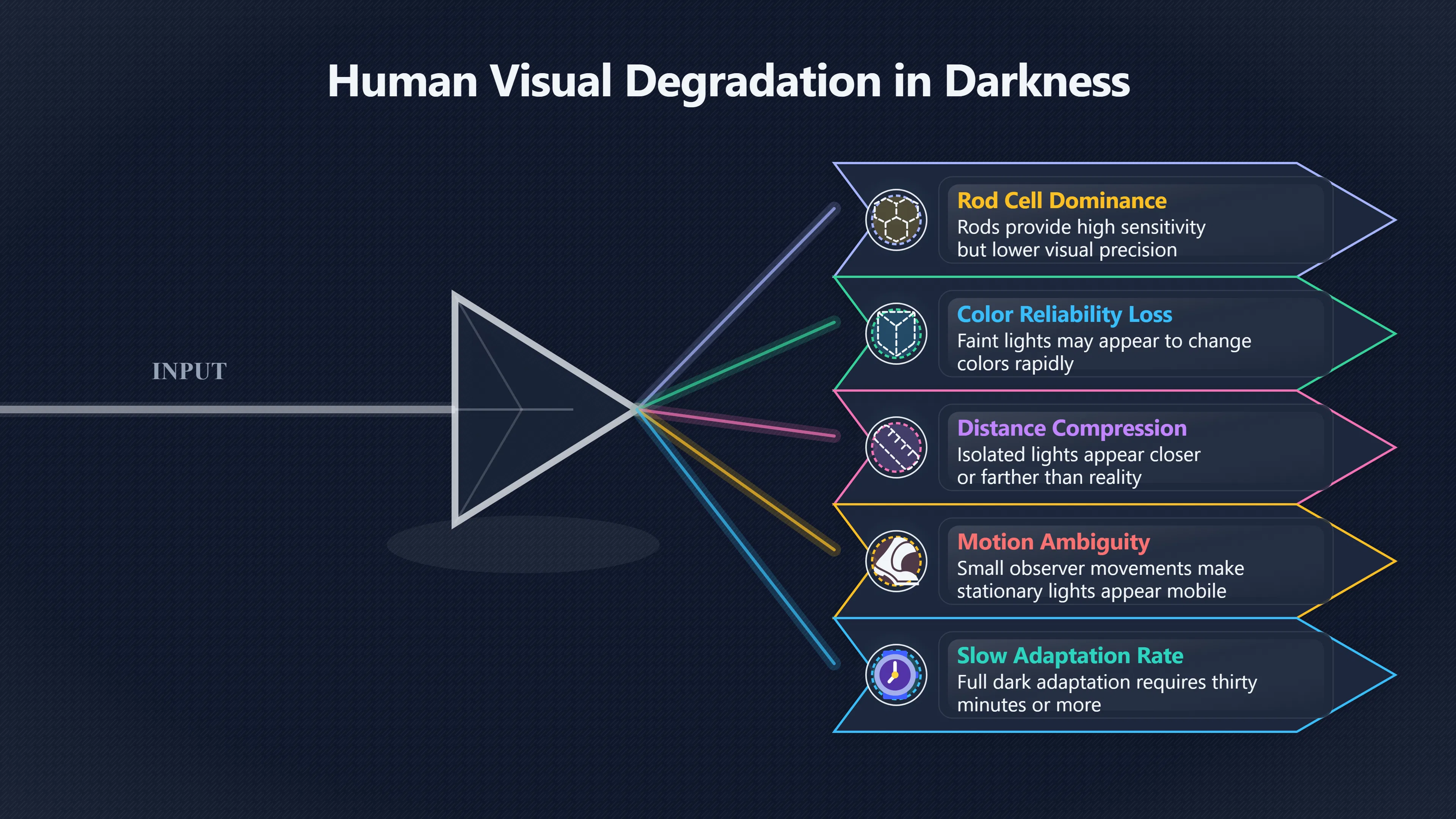
Human vision changes fundamentally in low light. During daylight, vision relies primarily on cone cells, which provide sharp detail, colour recognition and strong depth perception. In darkness, rod cells become dominant. Rods are highly sensitive to light but provide poorer visual acuity and little colour information. The trade-off is increased sensitivity at the cost of precision.[Skybrary]skybrary.aeroVision (OGHFA BN)Photopic vision is thus mainly the result of cones activation, and is therefore characterized by high acuity, co…
Dark adaptation is also slow. Full adaptation can require roughly 30 minutes or more, and exposure to bright light can partially reset the process. Even trained personnel can experience temporary degradation if they move between illuminated and dark areas or encounter sudden bright lights. Aviation and military night-operations guidance consistently warns that dark adaptation, visual acuity and depth perception are all reduced at night.[FAA+3Flight Safety Foundation+3ROSA P]flightsafety.orgin the darkFlight Safety FoundationIn the Dark20 Jan 2017 — When moving from a lighted environment into darkness, the ability to see is initially im…
Several specific perceptual problems become more likely:
- Distance compression or expansion: isolated lights can appear much closer or farther away than they really are.
- Loss of colour reliability: faint lights may appear to change colour or display colours that are difficult to verify.
- Reduced detail recognition: a bright point source may be visible while its true shape remains impossible to identify.
- Motion ambiguity: small changes in observer position can make stationary lights appear to move.[FAA+2Airport Lights Inspection]faa.govChapter 13: Night OperationsChapter 13: Night OperationsMarch 8, 2019 — • Limitations in visual acuity, dark adaptation, and color and depth perception. For examp…
These limitations are important because many Rendlesham descriptions involved distant lights seen through trees, intermittent visibility and uncertainty about range.
Why Trained Observers Still Misread Lights
Training improves procedures, not eyesight. Military personnel can be taught scanning techniques, observation methods and reporting discipline, but they remain dependent on the same retinal mechanisms as everyone else. Military and aviation guidance repeatedly emphasises that operators must learn to compensate for night-vision weaknesses because those weaknesses cannot be eliminated.[University of Glasgow DCS+2Training Command]dcs.gla.ac.uks important to train individuals to avoid the rapid head or eye movements that reduce our ability to assimilate information in low light…
Research on distance estimation illustrates this distinction clearly. Studies of observers using night-vision systems found that unguided estimates of distance were often inaccurate. Training with direct feedback improved performance, but the need for such feedback demonstrates that distance perception under low-light conditions is not naturally reliable. Even after training, accuracy depends heavily on familiarity with the specific environment and available visual cues.[PubMed+2ResearchGate]pubmed.ncbi.nlm.nih.govThose distances ranged from 7.6 m (25 ft) to 64 m (210 ft).Read more…
This is a crucial point for interpreting witness credibility. A trained observer can honestly and accurately report seeing a bright light apparently moving through a forest while still being mistaken about its distance, size or location. Credibility and perceptual accuracy are not the same thing.
Military research into night-vision equipment reaches similar conclusions. Even sophisticated optical aids can introduce distortions in depth perception and spatial judgement, requiring additional training to reduce errors. The persistence of these problems despite specialised equipment underscores how difficult accurate night perception can be.[Indian Journal of Aerospace Medicine+2GovInfo]indjaerospacemed.comMaterials and Methods. The study was conducted indoors in the NVG Training Laboratory at the…Read more…

Expectation Does Not Cancel Expertise
A common misunderstanding is that professional experience makes observers immune to expectation effects. In reality, expertise can help identify threats but does not eliminate interpretation under uncertainty.
Security personnel investigating a possible aircraft crash, intrusion or emergency are actively searching for meaningful explanations. When visual information is incomplete, the brain attempts to fit ambiguous stimuli into a coherent picture. This process occurs automatically and affects experts as well as non-experts. Night-operations training therefore focuses on recognising limitations and avoiding overconfidence, not on assuming that trained observers are incapable of perceptual error.[University of Glasgow DCS+2FAA]dcs.gla.ac.uks important to train individuals to avoid the rapid head or eye movements that reduce our ability to assimilate information in low light…
How Night Perception Applies to Rendlesham
Applied to the Rendlesham Forest incident, night-vision science suggests a more nuanced interpretation than either complete dismissal or unquestioning acceptance.
The witnesses were not casual observers. Their training likely improved their ability to notice unusual lights, navigate the area and provide detailed reports. At the same time, the reported conditions contained many of the elements known to challenge night perception:
- Darkness with limited reference points.
- Intermittent views through woodland.
- Bright isolated lights against a dark background.
- Uncertain distances.
- A developing belief that something unusual had landed nearby.[FAA+2Flight Safety Foundation]faa.govChapter 13: Night OperationsChapter 13: Night OperationsMarch 8, 2019 — • Limitations in visual acuity, dark adaptation, and color and depth perception. For examp…
Under such circumstances, trained personnel could accurately report unusual visual experiences while still misjudging key characteristics of what they were observing. A distant beacon, star, aircraft light or other source might be perceived as closer, moving differently or possessing greater structure than it actually had. The witness testimony therefore remains valuable evidence about what was experienced, but the known limitations of human night vision caution against treating every perceived detail as a precise description of an external object.[FAA+2PubMed]faa.govChapter 13: Night OperationsChapter 13: Night OperationsMarch 8, 2019 — • Limitations in visual acuity, dark adaptation, and color and depth perception. For examp…
Training Reduces Errors but Does Not Remove Them
The strongest lesson from night-vision research is not that trained observers are unreliable. It is that they remain human observers operating within well-documented physiological limits.
Military organisations devote substantial effort to night-vision training precisely because darkness degrades perception. If training alone solved the problem, there would be no need for specialised procedures, equipment and repeated instruction. The existence of extensive night-operations guidance is itself evidence that acuity, colour perception, depth judgement and distance estimation remain vulnerable after training.[FAA+2Training Command]faa.govChapter 13: Night OperationsChapter 13: Night OperationsMarch 8, 2019 — • Limitations in visual acuity, dark adaptation, and color and depth perception. For examp…
In the Rendlesham context, this means witness training increases the importance of the perception question rather than eliminating it. Professional observers may provide more careful testimony than untrained civilians, but the biological limits of human night vision remain an essential part of any explanation for what was seen in the forest.[FAA+2Skybrary]faa.govChapter 13: Night OperationsChapter 13: Night OperationsMarch 8, 2019 — • Limitations in visual acuity, dark adaptation, and color and depth perception. For examp…

Amazon book picks
Further Reading
Books and field guides related to Why Training Cannot Fix Night Vision. Use these as the next step if you want deeper reading beyond the article.
Thinking, Fast and Slow
Explains why expertise cannot fully overcome cognitive shortcuts and uncertainty.
The Demon-Haunted World
Places witness claims and trained-observer testimony within critical evidence standards.
The Invisible Gorilla
Directly supports the argument that attention and confidence do not guarantee accurate perception.
Visual intelligence
Addresses how trained looking works and where observation can still fail.
eBay marketplace picks
Marketplace Samples
Example marketplace items related to this page. Use the search link to explore similar finds on eBay.



Endnotes
1.
Source: faa.gov
Title: Chapter 13: Night Operations
Link:https://www.faa.gov/sites/faa.gov/files/Night_Ops_Ch13.pdf
Source snippet
Chapter 13: Night OperationsMarch 8, 2019 — • Limitations in visual acuity, dark adaptation, and color and depth perception. For examp...
Published: March 8, 2019
2.
Source: skybrary.aero
Link:https://skybrary.aero/articles/vision-oghfa-bn
Source snippet
Vision (OGHFA BN)Photopic vision is thus mainly the result of cones activation, and is therefore characterized by high acuity, co...
3.
Source: rosap.ntl.bts.gov
Link:https://rosap.ntl.bts.gov/view/dot/21524/dot_21524_DS1.pdf
Source snippet
Dark adaptation is the process by which the eyes adapt for optimal night visual acuity under conditions of low.Read more...
4.
Source: dcs.gla.ac.uk
Link:https://www.dcs.gla.ac.uk/~johnson/papers/night_accidents.pdf
Source snippet
s important to train individuals to avoid the rapid head or eye movements that reduce our ability to assimilate information in low light...
5.
Source: researchgate.net
Link:https://www.researchgate.net/publication/277736574_Distance_Estimation_with_Night_Vision_Goggles_A_Direct_Feedback_Training_Method
Source snippet
(PDF) Distance Estimation with Night Vision GogglesDirect feedback training appears to be more effective at improving performance at dist...
6.
Source: researchgate.net
Link:https://www.researchgate.net/publication/329544248_Darkness_visible_accurate_distance_estimation_with_a_night_vision_device
Source snippet
Observers estimate distances more accurately when given...Read more...
7.
Source: govinfo.gov
Title: GOVPUB D101 PURL gpo2599
Link:https://www.govinfo.gov/content/pkg/GOVPUB-D101-PURL-gpo2599/pdf/GOVPUB-D101-PURL-gpo2599.pdf
Source snippet
The Effects of Viewpoint Offsets of Night Vision Goggles on...The results of the study indicated that wearing NVGs with hyperstereo view...
8.
Source: flightsafety.org
Title: in the dark
Link:https://flightsafety.org/asw-article/in-the-dark/
Source snippet
Flight Safety FoundationIn the Dark20 Jan 2017 — When moving from a lighted environment into darkness, the ability to see is initially im...
9.
Source: atsb.gov.au
Link:https://www.atsb.gov.au/sites/default/files/2024-05/FAA-H-8083-3B%20Chapter%2010.pdf
Source snippet
NIGHT VISIONThe pilot before and during night flight must consider the adaptation process of the eyes. First, the eyes should be allowed...
10.
Source: tarmacview.com
Link:https://www.tarmacview.com/glossary/night-operations/
Source snippet
Airport Lights InspectionNight Operations | Airport Lights InspectionNight operations pose unique risks due to reduced visibility, compro...
11.
Source: trngcmd.marines.mil
Title: Training Command
Link:https://www.trngcmd.marines.mil/Portals/207/W260007XQ%20-%20Observation%20Theory.pdf?ver=2017-01-24-161216-810
Source snippet
Introduction to Observation Theory and Night Optics24 Jan 2017 — In order for the Marine Corps to effectively fight during the night we n...
12.
Source: pubmed.ncbi.nlm.nih.gov
Link:https://pubmed.ncbi.nlm.nih.gov/10665216/
Source snippet
Those distances ranged from 7.6 m (25 ft) to 64 m (210 ft).Read more...
13.
Source: indjaerospacemed.com
Link:https://indjaerospacemed.com/analysis-of-problems-with-distance-determination-using-night-vision-googles/
Source snippet
Materials and Methods. The study was conducted indoors in the NVG Training Laboratory at the...Read more...
14.
Source: pubmed.ncbi.nlm.nih.gov
Link:https://pubmed.ncbi.nlm.nih.gov/10665217/
Source snippet
of "distance estimation with night vision gogglesby PR DeLucia · 1999 · Cited by 41 — They raised interesting questions about distance es...
Additional References
15.
Source: cfinotebook.net
Link:https://www.cfinotebook.net/notebook/aeromedical-and-human-factors/the-eyes-and-vision
Source snippet
The Eyes & VisionNight vision requires dark adaptation and can be degraded by bright lights... vision, especially during night operation...
16.
Source: jsyx.magtechjournal.com
Link:https://jsyx.magtechjournal.com/EN/10.7644/j.issn.1674-9960.2024.03.001
Source snippet
perception and the role of depth perception training in improving depth perception.Read more...
17.
Source: science.gov
Link:https://www.science.gov/topicpages/a/army%2Bnight%2Bvision.html
Source snippet
s in infrared images. This data offered...Read more...
18.
Source: youtube.com
Title: The Rendlesham UFO Encounter and the Alien Message from the Future
Link:https://www.youtube.com/watch?v=9kUromZCP9M
Source snippet
Rendlesham Forest UFO incident skeptic lighthouse explanation Lighthouse Skeptic Vince Thurkettle The Rendlesham Forest Incident...
19.
Source: entokey.com
Title: night vision and military operations
Link:https://entokey.com/night-vision-and-military-operations/
Source snippet
27 Aug 2017 — A minimum distance visual acuity of 20/40 in at least one eye with or without eyeglasses is required by the Army and Navy t...
20.
Source: pilot-protection-services.aopa.org
Title: everything is different at night
Link:https://pilot-protection-services.aopa.org/news/2022/december/01/everything-is-different-at-night
Source snippet
Is Different at Night1 Dec 2022 — Without breathing supplemental oxygen in an unpressurized airplane at night there is at least a 35% red...
21.
Source: learntoflyblog.com
Title: Human Factors: Night Vision Adaptation
Link:https://learntoflyblog.com/human-factors-night-vision-adaptation/
Source snippet
Several things can be done to help with the dark adaptation process and to keep a pilot's eyes adapted to darkness...
22.
Source: youtube.com
Title: The Army’s new night vision is SCARY!
Link:https://www.youtube.com/watch?v=oiZwxUuX_0k
Source snippet
Marine reactsSuper impressive, but also pretty scary to think how fast technology is advancing #nightvision #envg. Nobody Tells You About...
23.
Source: info.ornl.gov
Link:https://info.ornl.gov/sites/publications/Files/Pub57090.pdf
Source snippet
of Special Operations Forces Using Night Vision...by CM Smith · 2001 · Cited by 1 — The limiting resolution of a system is the spatial f...
24.
Source: inviewmedical.pl
Link:https://www.inviewmedical.pl/wp-content/uploads/2015/08/Vision-Stds-for-Aircrew.pdf
Source snippet
Vision Standards for Aircrew: Visual Acuity for Pilotsby JK Kumagai · 2005 · Cited by 9 — Visual functions included contrast sensitivity...
Topic Tree